
MMU Contributes to the International Discussion on Metropolitan Future in Milan
Hosted by the Metropolitan City of Milan in cooperation with the Organisation for Economic Co-operation and Development (OECD) on 18-19 November 2026, the event brought together international stakeholders to discuss the future of metropolitan areas, polycentric development and the governance of functional urban areas, two decades after the publication of the first OECD Territorial Review of Milan.
OECD Territorial Scan and the Metropolitan Agenda
The programme commenced with opening remarks by Giuseppe Sala, Mayor of Milan, and Giorgio Mantoan, Councillor for Economic Development, followed by a presentation of the findings of the OECD Territorial Scan by OECD experts Claudia Baranzelli and Oriana Romano.
The OECD’s territorial scans serve as comprehensive strategic analytical tools that examine the demographic, economic, spatial and environmental dynamics of urban or metropolitan regions, assess existing governance capacities and provide evidence-based policy recommendations to address structural challenges. In the case of Milan, the scan seeks to inform the city’s metropolitan governance model for the coming decades by addressing key issues such as housing, skilled human capital, polycentric development, mobility and financing the green transition.
MMU at the Heart of European Metropolitan Governance Discussions
Later in the event, an international session entitled “From European Metropolitan Cooperation to the Metropolitan Resolution” was held, opened by Marco Griguolo, Councillor for Mobility and Transport of the Metropolitan City of Milan and President of the Network of European Metropolitan Regions and Areas (METREX).
Structured around two roundtable discussions, the first part of the session was moderated by Paolo Manfredi and featured Eva García Chueca, representing European Metropolitan Authorities (EMA) and the Barcelona Metropolitan Area (AMB); Thomas Kiwitt from the Stuttgart Region; Sébastien Rolland from the Lyon Urban Planning Agency; Laura Papaleo from Genoa; and Sonia Cambursano from Turin. In this session participants discussed shared policy priorities across European metropolitan areas, opportunities for sustained cooperation in addressing challenges that extend beyond the capacity of individual authorities, the integration of spatial planning and transport, and digital transformation processes.
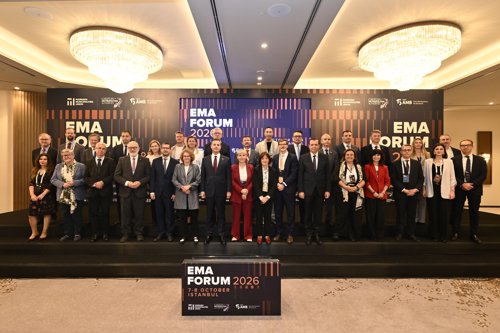
The meeting provided a strong institutional foundation for the “Metropolitan Resolution Call” initiative pursued by the AMB and the MetroHUB Centre at Politecnico di Milano in collaboration with UN-Habitat. The regional dialogue, reinforced through the 2026 EMA Forum held in Istanbul, one of the key platforms for metropolitan governance discussions in Europe, gained a global dimension through the meeting in Milan. The summit also reaffirmed MMU’s active engagement in European metropolitan networks and policy discussions.
M. Cemil Arslan, Secretary General of MMU, participated as a speaker in the second roundtable discussion, entitled “Towards a Political and Institutional Mandate for a Metropolitan Framework”. The roundtable also brought together Fiona McCluney and Rafael Tuts from UN-Habitat, Valeria Fedeli from Politecnico di Milano, Maria Peix from the AMB, Cristiana Scorza Guimaraens from Brazil’s Ministry of Cities, Nosipho Hlatshwayo from the South African Cities Network (SACN), Valentin Bayiri from the Municipality of Ouagadougou, and Claudio Augugliaro from the Ciudadanía Metropolitana platform.
The discussion focused on translating regional consensus into a shared political mandate encompassing national governments and advancing the draft resolution for consideration by United Nations Member States. Alongside the contributions of scientific cooperation and civil society to the process, participants explored regional experiences from Africa and Latin America, the role of municipal associations in strengthening the global metropolitan agenda, and lessons learned from regional cooperation in the Marmara Region.
Support from national governments and cooperation with universities are critical
Speaking on 19 November 2026, the final day of the programme, during a session addressing the roadmap and institutional responsibilities associated with the draft Metropolitan Resolution, M. Cemil Arslan emphasised that support from national governments was critical to the success of a global resolution. Arslan highlighted the need to recognise differences in metropolitan powers and responsibilities across countries. He also stressed the importance of involving the Government of Türkiye and UN-Habitat’s regional office in Türkiye in the process, while underlining the vital role of institutional cooperation between local governments and universities in evidence-based policymaking.
At the conclusion of the two-day summit and working sessions, participants reached agreement on a voluntary statement of commitment to advancing the political and institutional recognition of the metropolitan scale, maintaining dialogue with UN-Habitat and United Nations Member States, and developing a joint roadmap with a broader group of stakeholders in 2027.