
Urban Health And Security Addressed At The 8th Migration Meeting
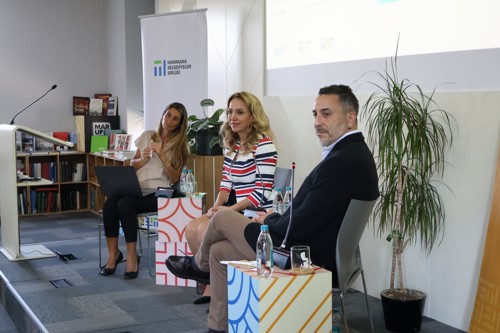
Duyar highlighted that rapid population growth caused by migration puts pressure on urban infrastructure and cities’ health system as well as increases the demand for municipal services. She touched on solutions that take the public health and security into account and help local authorities to manage this difficult situation. Duyar emphasized the importance of developing cooperation with different stakeholders, which may contribute to increase in the resources of municipalities. She also underlined the necessity for holistic and inclusive planning focused on data-driven measures in order to create a healthy and secure city in which social consensus and cohesion are secured. Duyar stated that space planning which is designed by methods like Crime Prevention Through Environmental Design (CPTED) would lead to change in human behavior, decrease in crime and violence, and increase in people’s feeling of security.
Duyar addressed different dimensions of urban health such as physical health, psycho-social health, food security and said “Individuals need healthy environment and the cities need healthy individuals to carry out their fuctions.” She emphasized that there are some useful recommendations for local authorities to build healthy cities and touched on some of them as mentioned in WHO’s publication titled “A healthy city is an active city: a physical activity planning guide.” Some of these recommendations for municipalities are the followings:
- To put the issue of health on the urban agenda
- To integrate the concept of health into spatial planning and urban development
- To incentivize physical activity through urban design
- To promote travel paths which are safe and which do not only depend on motor vehicles
- To create safe public open space systems in throughout the city
- To develop clear and waste water infrastructure
- To secure healthy food supply through supporting local and urban design
Duyar also mentioned the importance of focusing on the development at the local level, of extending the stakeholder participation in order to create wider consensus on social values and norms, of diversifying resources, of defining risks and taking measures accordingly.